Back to Systems

A 10-week analysis engagement, and a tool that checks its business rules.

Both follow the method I use on every project, understand first and then build: business rules are agreed and checked for conflicts before anyone designs a schema or writes code.

SYSTEMS / BUSINESS ANALYSIS

NordPay A/S logo NordPay A/S

From a messy process to working software in 10 weeks.

I find it more useful to show how I work than to list skills. This case study walks through a complete business analysis engagement, from a one-page problem statement to an MVP running in production, with every deliverable and what it concretely produced.

About this case study. NordPay A/S is a fictional Danish payments fintech based in Copenhagen. The engagement is a realistic example of the work I have done in previous roles: the process, artefacts, decisions, and numbers reflect how I operate.
Client
NordPay A/S
Industry
Fintech · payments
Location
Copenhagen
Duration
10 weeks
Outcome
Working MVP in production

THE BRIEF

Transaction management digitalisation.

Client

Danish payments fintech, ~150 employees

Problem

300+ daily transactions reconciled through Excel and email, with no single source of truth

Cost

~€22,000 per month in reconciliation errors and chargeback fees

Ask

A web-based transaction management platform integrated with the core banking ledger

Constraints

No operational downtime · GDPR · €250K budget

Delivered

MVP live in 10 weeks · 0 scope changes after sign-off

RESULTS

What the analysis delivered.

Illustrative outcomes for this fictional engagement, calculated the same way I would report real ones.

−61% Reconciliation errors

within 3 weeks of go-live

−83% Time per transaction

from 23 minutes to 4 minutes

0 Scope changes after sign-off

across 3 sprints

10 wk Time to Sprint 1 live

the client had estimated 6 months

€22K Saved per month

ROI payback in 12 months

+38% Developer velocity

from Sprint 1 to Sprint 3

HOW I WORK

Understand first, then build.

Two phases, plus team management running throughout. Every step has a named deliverable and a concrete effect on the project. Select a step to jump to it.

Phase 2 · Weeks 5–10

Proof of concept

Translate understanding into requirements and working software.

  1. Prototype & usability
  2. Backlog & prioritisation
  3. Requirements & Definition of Done
Continuous

Team management

Governance that keeps scope and people aligned.

  1. Steering & RACI
  2. Change control
  3. Delivery timeline
Phase 1

Discovery & alignment

Understand the problem before touching the solution.

01Week 1

Problem statement

A one-page brief defining who is affected, what the problem is, and why it matters.

“NordPay loses €22K/month because ops staff reconcile transactions across 4 disconnected sources, creating settlement conflicts with no single source of truth.”

Outcome Approved by the CFO and CTO in Week 1, and used as the scope north star for the whole engagement.
02Week 1

Business case

The cost of keeping the manual process, compared with the cost of replacing it.

Build cost€250K
Errors avoided€264K / year
Payback12 months

Outcome Approved the same day. The project went ahead with no further budget discussion.

03Weeks 1–2

Stakeholder interviews

Six interviews, some of them iterative, to map each stakeholder's needs and influence on the project.

  • Ops manager
  • 2 reconciliation analysts
  • Risk & Compliance lead
  • Finance
  • Merchant Support

Key find Merchant Support revealed that merchants called every day to ask about settlement status. This was not in the original brief, and became the Merchant Portal feature.

04Week 2

Domain glossary

26 terms defined and agreed across departments in Week 2.

“transaction”
Risk an authorised event Finance a settled ledger entry Operations a reportable case

Critical find “Transaction” meant three different things to Risk, Finance, and Operations. Resolving it before the first wireframe prevented about 3 weeks of back-and-forth in development.

05Week 2

User personas

Three personas with day-in-the-life scenarios, describing each user's goals, behaviour, and frustrations.

Reconciliation analyst

GoalProcess transactions fast

FrustrationSwitching between 4 systems per transaction

Ops manager

GoalReal-time settlement visibility

FrustrationNo dashboard, everything is in email

Merchant

GoalKnow settlement status

FrustrationCalling to chase confirmations

06Week 3

User journey mapping

Journeys mapped for all three personas across the transaction lifecycle: workflows, touchpoints, pain points, and information needs.

Key find Two touchpoints in the existing process had no digital equivalent. They became requirements for the Fraud Analyst Console and the Merchant Portal before wireframing began.

07Week 3

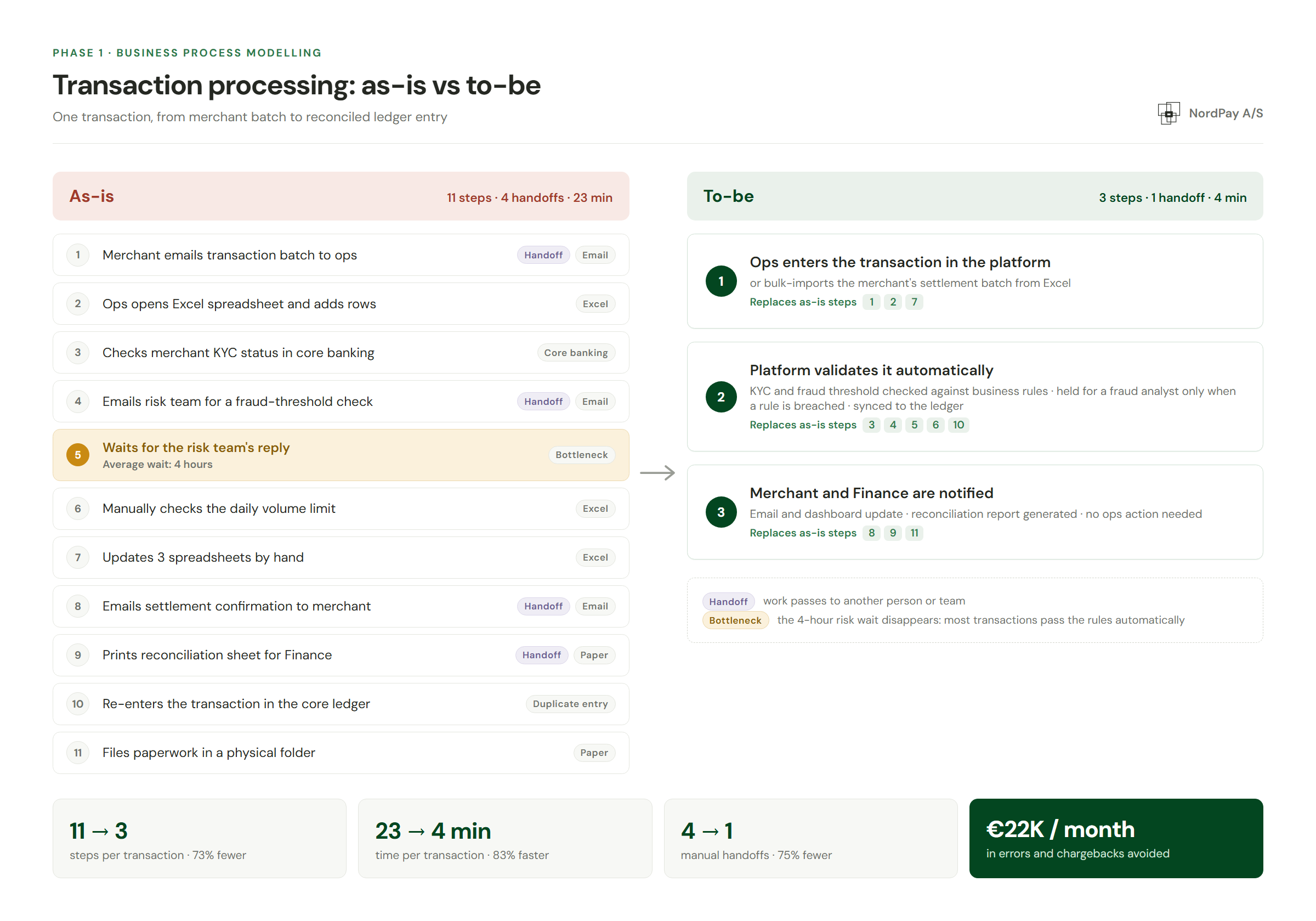
As-is / to-be analysis

The current transaction process was mapped step by step to find unnecessary steps and manual dependencies, then redesigned and validated with stakeholders.

As-isTo-be
Steps per transaction113
Manual handoffs41
Time per transaction23 min4 min
Data sources41
As-is transaction process with 11 manual steps and 4 handoffs taking 23 minutes, compared with a to-be process of 3 steps taking 4 minutes View full size ↗
08Week 3

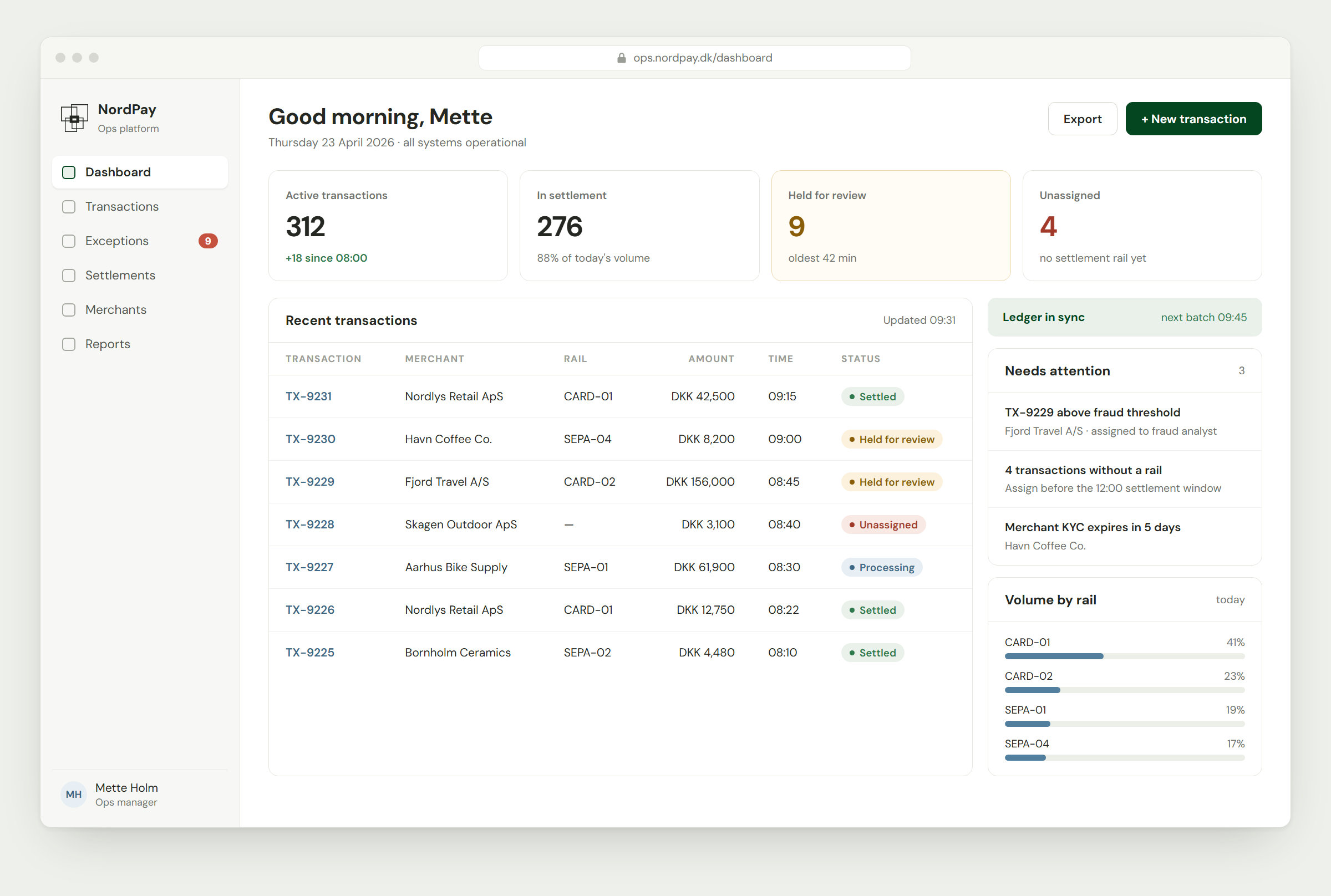
Wireframes & walkthrough

8 screen flows built in Figma over 3 days, then validated in a 90-minute stakeholder walkthrough so everyone shared the same picture of the solution.

Dashboard for the ops manager with active, settling, held, and unassigned transactions, a recent transactions table, and ledger sync status

Ops manager persona · real-time view of transactions, settlements, held items, and ledger sync.

Outcome 2 minor label changes and zero functional changes in the walkthrough. Scope locked.

09Week 4

Assumptions & constraints

11 assumptions and constraints documented and tracked.

Most impactful The core banking ledger API is rate-limited to 100 calls per minute. This shaped the entire sync architecture (a 15-minute asynchronous settlement queue), and was caught here rather than in Sprint 3.

10Week 4

Business rules

17 rules captured before the schema was designed, not after something broke. Two examples:

Merchant identity

A merchant cannot exist twice under two internal IDs. Every reference points to one real merchant.

Fraud hold

A transaction above 90% of the merchant's fraud threshold, or with unusual activity, is held for a fraud analyst instead of being approved automatically.

Outcome Agreeing the rules up front prevented 3 architecture debates later in development.

Try it yourself. Check rules like the fraud hold for contradictions in the Requirements Verifier.
11Week 4

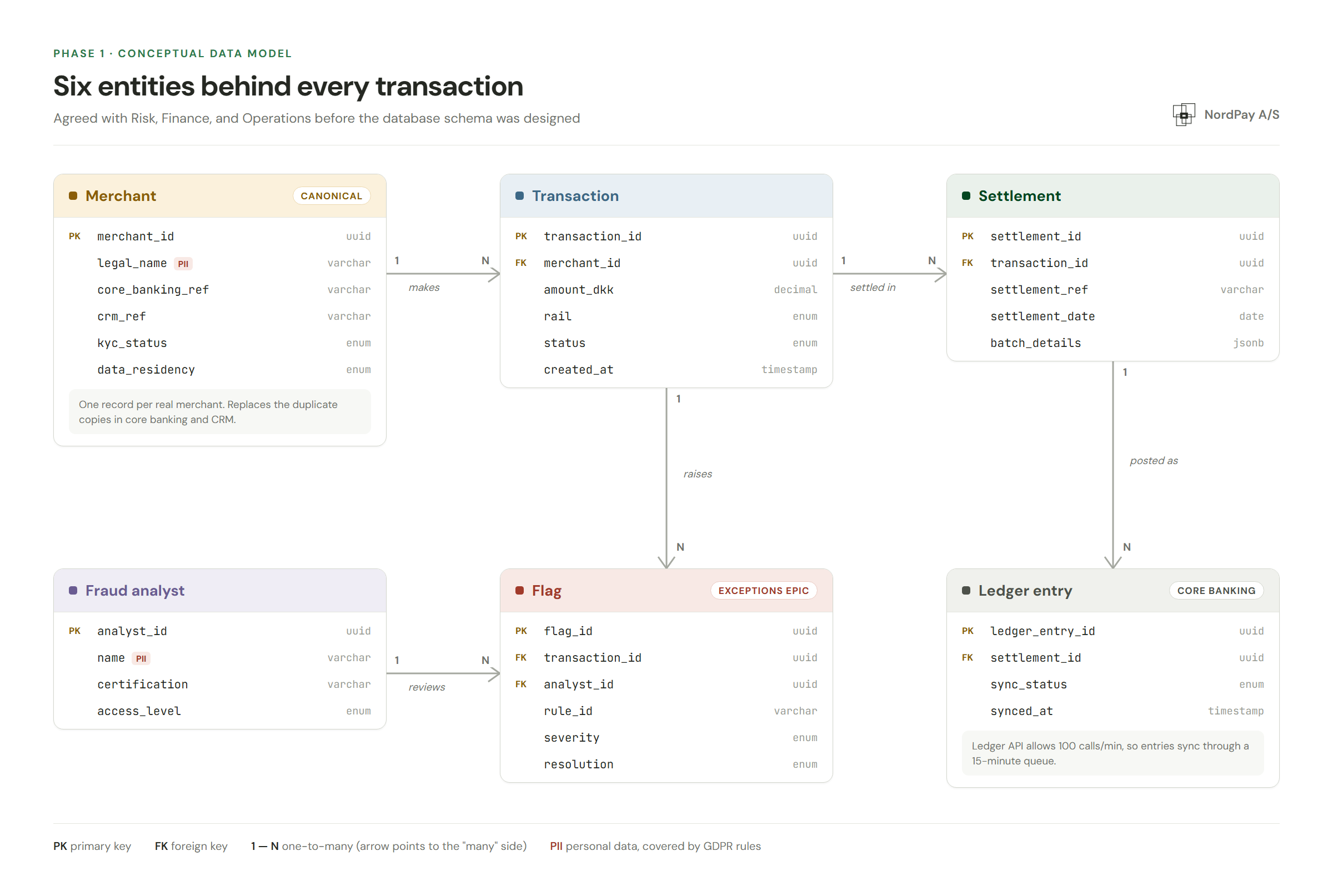
Conceptual data model

  • 6 entities
  • 17 business rules
  • 1 duplication resolved
Conceptual data model with six entities: Merchant, Transaction, Settlement, Fraud analyst, Flag, and Ledger entry, and their one-to-many relationships View full size ↗

Outcome The “Merchant” entity existed twice, in core banking and in the CRM. It was resolved into one canonical merchant before the database schema was created.

12Week 4

Non-functional requirements

19 requirements covering how the system must behave, not just what it does.

Performance

<2s page load · <500ms API · 60 concurrent users

Availability

99.5% SLA · graceful degradation when the ledger is offline

Security

Role-based access (4 levels) · encryption at rest and in transit · full audit log

Compliance

GDPR · PSD2 strong customer authentication · DORA operational resilience · Danish data residency · PII and PCI fields flagged in the data model

Phase 2

Proof of concept

Translate understanding into requirements and working software.

13Weeks 5–6

Prototype & usability sessions

The wireframes became a working prototype that real analysts could click through, not just review.

  • 9 pages, each traceable to a user goal
  • 38 user actions written as dev specs
  • 5 usability sessions with real analysts

Each user action was specified as trigger → decision → outcome, so developers could build directly from it.

Key find Bulk settlement import was critical for analysts but missing from scope. It was added as a Must-Have and approved within 24 hours.

14Weeks 6–7

Backlog & prioritisation

The validated prototype pages became a prioritised, sprint-ready plan: 5 epics and 51 user stories. The proof of concept covered core functionality only.

13 Must 8 Should 5 Could 3

MoSCoW · Must · Should · Could · Won't

Ambiguity per story 3.1 → 0.4

questions per story after weekly refinement, with velocity up 38%

MoSCoW prioritisation 3 weeks saved

by keeping Should and Could items out of the MVP

Sprint 1 goal

“An analyst at NordPay can create and submit a transaction digitally, without touching Excel.”

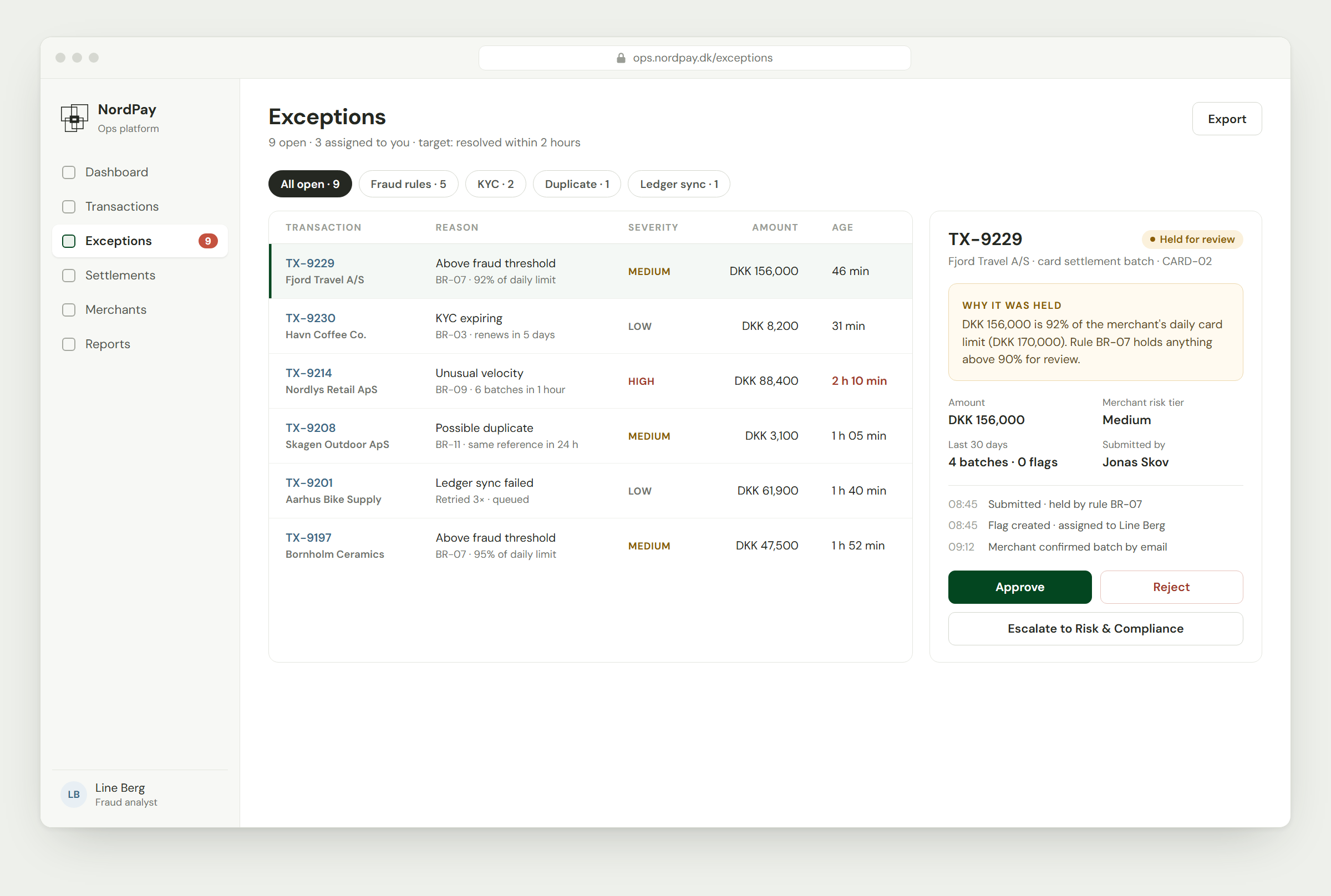
Proof-of-concept scope
EpicPoC featureUser story
Transaction intakeNew transaction · ValidationCreate a single transaction · Hold a transaction above the fraud threshold
Exception managementFlagView all flagged transactions in one place
IntegrationsLedger syncSync confirmed transactions to the core banking ledger
15Weeks 7–8

Requirements & Definition of Done

What “done” means for each story: testable, unambiguous, and agreed before development starts.

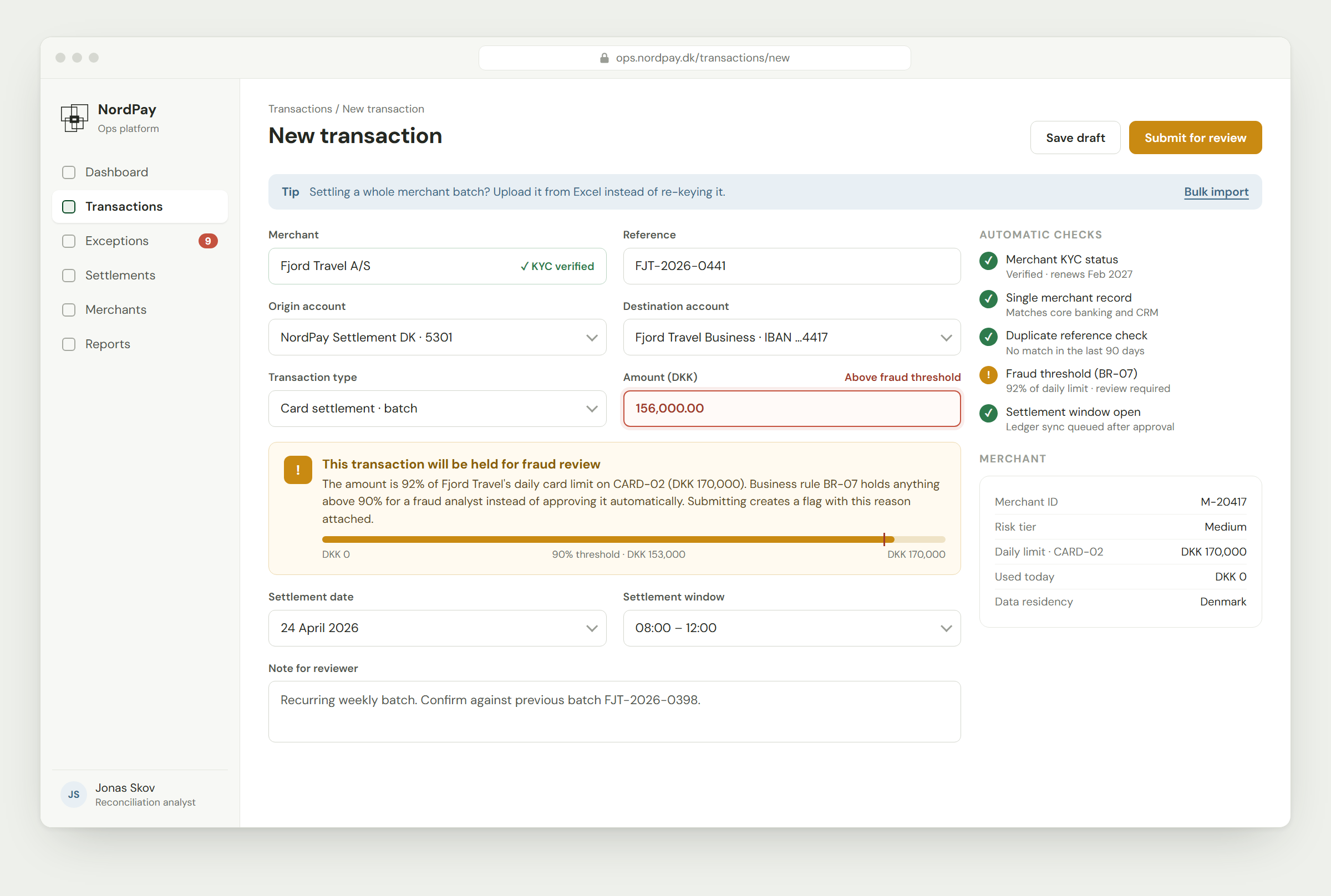
As a reconciliation analyst, I want to create a single transaction with automatic fraud-threshold validation, so that only risky transactions wait for review.

Given
an analyst enters the transaction details
When
the amount is within the merchant's fraud threshold
Then
the transaction is created as authorised, with no manual review
Given
an analyst enters the transaction details
When
the amount exceeds the merchant's fraud threshold
Then
the transaction is held, a flag is created, and the analyst sees why it was not approved automatically

Edge cases 34 documented. The most impactful: if the ledger times out, transactions wait in a 15-minute local queue with the sync status shown, and no analyst action is needed.

Ratified by development, QA, and the business

  • Code reviewed and merged
  • Unit tests passing
  • All acceptance criteria verified by QA
  • GDPR and PSD2 reviewed for stories touching PII or card data
  • Performance tested at 60 concurrent users
  • Product owner sign-off in staging

Sign-off Stakeholders signed off in Week 7, followed by zero scope changes in Sprints 1–3.

CONTINUOUS · TEAM MANAGEMENT

Governance without the overhead.

Weekly steering

A 30-minute RAG status for the CFO and CTO. 4 change requests logged: 2 approved, 2 deferred.

RACI matrix

Making Finance Consulted rather than Accountable on the data model eliminated a 3-week back-and-forth.

Change control

Bulk settlement import: a 2-day impact assessed and approved within 24 hours, with zero sprint disruption.

Meeting cadence

Steering, refinement, stand-up, and sprint review in just

2 h 45 min / week

DELIVERY TIMELINE

10 weeks, against a 6-month estimate.

  1. W1

    Problem statement + business case

    NPV model approved by CFO and CTO · 3 stakeholder interviews completed

  2. W2

    User personas + domain glossary

    3 remaining interviews · 3 personas finalised · 26-term glossary, “transaction” ambiguity resolved

  3. W3

    Process modelling + wireframes

    As-is / to-be mapped (11 → 3 steps) · 3 journey maps · 8 screen flows in Figma

  4. W4

    Data model + NFRs + scope lock

    6 entities · 17 business rules · 19 NFRs · stakeholder walkthrough, scope baselined

    Scope locked
  5. W5–6

    Prototype + usability sessions

    9 pages · 38 user actions · 5 usability sessions · bulk settlement import added as Must-Have

  6. W6–7

    Backlog + stakeholder sign-off

    5 epics · MoSCoW applied · 51 user stories · sign-off at the end of Week 7

    Signed off
  7. W7–8

    Full requirements + Definition of Done

    All acceptance criteria in Given/When/Then · 34 edge cases · 6-point DoD ratified by dev, QA, and compliance

  8. W8–10

    Sprint 1 live for the ops team

    Transaction intake live in production · Sprints 2–4 planned · 0 scope changes after sign-off

    Live in production

SKILLS REFERENCE

21 skills, each with evidence.

Discovery & alignment

  • Problem statement1-page brief, C-suite approved in Week 1
  • Business caseNPV model, 12-month payback
  • Stakeholder interviews6 interviews, hidden need surfaced
  • User personas3 personas, day-in-life scenarios
  • Domain glossary26 terms, “transaction” ambiguity resolved
  • Assumptions & constraints11 items, ledger API limit shaped architecture
  • As-is / to-be11 → 3 steps, 83% time reduction
  • User journey mapping2 missing touchpoints found
  • Wireframes & walkthrough8 screens, scope locked in 90 min
  • Conceptual data model6 entities, duplication resolved
  • Business rules17 rules, 3 architecture debates prevented
  • Non-functional requirements19 requirements: GDPR, PSD2, DORA, RBAC

Proof of concept

  • Pages & user actions9 pages, 38 actions as dev specs
  • Usability feedback5 sessions, critical gap found pre-build
  • Epics & prioritisationMoSCoW, 3 sprint weeks saved
  • Backlog refinementAmbiguity 3.1 → 0.4 per story
  • Sprint planningOutcome-based goals, not task lists
  • User stories & AC51 stories, QA tests written from AC
  • Edge cases & DoD34 cases, 6-point DoD ratified
  • Stakeholder sign-offWeek 7, 0 scope changes in 3 sprints

Continuous

  • Team managementRACI, status updates, change log, cadence

BEYOND THE PROOF OF CONCEPT

The full product scope.

EpicKey featuresUser stories
Transaction intakeNew transaction · Bulk settlement import · ValidationCreate a single transaction · Import a merchant settlement batch from Excel · Hold a transaction above the fraud threshold
Exception managementFlag · Resolve · EscalateView all flagged transactions in one place · Approve or reject a held transaction · Escalate a case to Risk & Compliance
Merchant portalSettlement status · NotificationsCheck settlement status without calling · Receive a settlement confirmation automatically
ReportingDaily reconciliation · Audit exportGet the daily reconciliation report automatically · Export the audit log for a compliance review
IntegrationsLedger sync · Core banking KYC · EmailSync confirmed transactions to the ledger · Check merchant KYC status automatically · Send email notifications